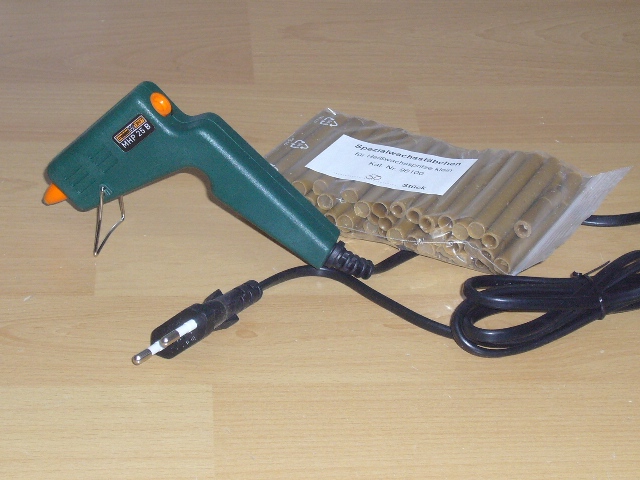
Small Hot Wax Injector
You, too, can restore wood parts damaged by woodworm using this time-saving and highly effective method. The hot wax, liquefied by the syringe, can be easily injected into the cavities; this not only seals them but also strengthens the wood by filling the cavities with wax. Historic or well-preserved material can often be saved this way and does not need to be replaced.
Please note: Construction lumber can only be treated using this method for cosmetic purposes. Structural restoration is neither possible nor permitted!
The hot wax injector liquefies the wax contained in wax sticks (which you must make yourself). By applying pressure to the stick, you inject the wax into the cavity through the wormhole by placing the nozzle on it. Compared to other methods, this injector allows the wax to penetrate deep into the wood. It is recommended to remove the borer dust beforehand by suction or blowing so that the wax can penetrate effectively.
Small electric hot wax injector without wax sticks, available at a discounted clearance price.
The hot wax injector is a simple, wax-compatible injector without an automatic feed mechanism.
Operating voltage 230 V 50 Hz
Power cord 1.5 m cable with Euro flat plug
You can also find materials for making your own wax sticks for the small hot wax injector or our professional large hot wax injector by clicking on the highlighted terms.
To produce these small wax sticks with an outer diameter of 8 mm and a length of approx. 60–80 mm, we recommend using brass tubes with an inner diameter of 8 mm and a wall thickness of 1 mm, which are filled with liquid wax and then pushed out of the tube after cooling.
Guidelines for Handling Woodworm-Infestated Objects
Wooden partsinfested by woodworms—or the so-called common furniture beetle—often raise concerns about further spread or the use of chemical agents that may subsequently evaporate into the indoor air.
The primary problem is the larvae of the so-called woodworm, which are deposited in large numbers in small cracks in the wood or shrinkage cracks, etc., by a fly that develops into the adult woodworm. These larvae can survive in the wood for years under adverse environmental conditions without any problems. Only when ideal conditions—such as high humidity and low temperatures—prevail do they develop further into woodworms, which then feed on dry wood and its components and do not emerge to the surface at first. It is only some time before the pupation stage—when it transforms into the aforementioned fly—that the woodworm bores the visible hole. However, visible holes do not automatically mean that an active infestation is present. The best indicator is woodworm sawdust that has recently been sifted out.
To combat the larvae and woodworms, in addition to chemical treatments, it is also possible to slowly heat the wood in specialized heat chambers to at least 55 °C while continuously regulating the wood’s moisture content. However, the core parts of the wood must also reach this temperature for at least 1 hour in order for the larvae and woodworms to die. Small pieces can possibly be subjected to this procedure in a sauna.
If the pieces of wood are stored for a winter in a room that is continuously heated by central heating, the pests will also die because the humidity is too low and the sustained temperature above 20 °C does not provide favorable conditions for woodworms.
If the above treatment options are not feasible, chemical pesticides can also be used, either by brushing, dipping, or injecting them into the worm tunnels. Specialized companies also offer fumigation in special chambers.
With all treatment methods, it is advisable to seal the wormholes afterward, at least on the surface. This makes it easy to determine whether the infestation has been eliminated by checking for new wood dust. If chemical substances are injected into the holes, sealing them partially prevents unwanted evaporation into the indoor air.
To seal the wormholes, we recommend our hot wax applicators, as the hot wax forms a very strong bond with the remaining wood, ensuring the hole remains permanently sealed.
If you need wax for cosmetic correction—the so-called “finishing touch”—we recommend our wood repair wax. This can be customized by mixing different colored waxes as needed. This wood repair wax is not suitable for technical hole filling, such as for woodworm holes.
You can find useful tips for working with wood at www.holzwerken.net